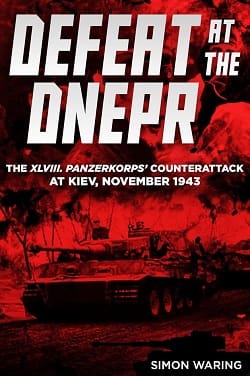
by Simon Waring
Hardback (6.3×9.3 inches). 420 pages. 2026.
Subtitle: The XLVIII PanzerKorps’ Counterattack at Kiev November 1943
I always get this sinking feeling when a book is a converted Masters or PhD thesis. Surprisingly, and thankfully, almost all the “academia prose” was banished from the text, leaving an exceptional tactical-operation recap and analysis of an East Front German counter-attack that lasted from November 3 through November 26, 1943.
Clear descriptions of planning and execution of attacks and defense, a horde of numbers and details about such actions, and superb use of excerpts (a nice sprinkling, not the oft-used ham-handed report/memoir info dumps on every page) make this a pleasure to read and digest.
Sure, all those tiny villages and town names kinda look alike to my wooden Western eyes, but I am pleased they are included so I can follow the action. Constant referencing to higher-level units helps establish and keep unit relationships within a general map area — that and flipping back and forth to the maps.
I am continually amazed at how panzer divisions would be ordered to attack despite having only a company worth of tanks operational — or less. The only German division with a relatively full complement was the newly formed and never battle-tested 25th Panzer Division. It went into combat piecemeal and without adequate recon, took heavy losses around Fastov, but at least stopped the southern and westward progress of two Soviet armies. The drip-drip-drip of German and Soviet losses from fighting over them all receive constant attention.
Kudos for reconciling post-war memoirs with actual reports. As this book covers the battle on a day by day basis, some recollections match up and some do not. The “delay” at relieving the logistics and transportation hub at
Zhitomyr gets a nice discussion — and an opportunity for a tabletop battle about what would happen if the panzers were not diverted to that town and instead used for an attack towards Kiev. Good fact checking and analysis here.
Any tabletop battle willhave to deal with the incessant rain during the counter-attack. On the one hand, both sides didn’t get any air support except for brief times. On the other, the mud was a disaster for movement, reflected in the importance of recapturing the Zhitomyr-Kiev paved highway.
The book contains 25 black and white photos, one black and white illustration, and 10 color maps (mix of operational and tactical). I would have liked to see the “key hills” mentioned in the text noted on the maps.
In the end, the counter-attack achieved some objectives and failed in others. Prepared Soviet defenses, aggressive recons, and constant reinforcements did more to end the counterattack than the mud. Read this book and you’ll know exactly why. Superb.
Enjoyed it.
— Reviewed by Russ Lockwood