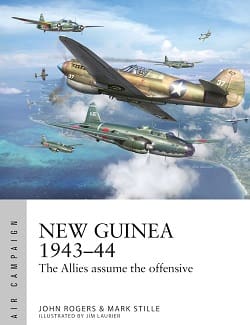
by John Rogers and Mark Stille.
Softcover (7.25×9.75 inches). 96 pages. 2026.
Subtitle: The Allies Assume the Offensive
This is the sequel to New Guinea 1942-43: Air Campaign 56 by the same authors and carries the war in the air forward. Besides the standard sitrep, commanders, and aircraft profiles, you get a considerable amount of air operations across New Guinea. Unless you’re a geography savant, you’ll need to refer to the color map (p20) to locate all the airfields and targets covered in the text.
Among all the details of X number of Y type of aircraft bombing, reconning, and dogfighting in and around New Guinea, you’ll understand how the Allies wrested air superiority away from the Japanese. The reasons are expertly summarized in the conclusion section, but the air raid numbers showed the US/UK mounting raids of 100+ aircraft while the Japanese rarely sent 50+ and often only a squadron or two. Don’t even think about comparing logistics…
Per usual, claims of aircraft destroyed far outnumbered the total aircraft in the entire theater, but thankfully, the numbers are mostly correlated with surviving enemy records.
The booklet contains 80 black and white photos, five color maps, and three color two-page action illustrations.
As for the latter illustrations, this is the first Osprey I found that seemed off — something odd with the first, more so in the second, and by the third, something definitely off. I looked a bit more at the third illustration and discovered the artist’s copy and paste actions were rather sloppily done. The warship on the left was obviously pasted in — there was even a rectangular vestige of the drop. Many of the shell splashes were copy and pasted with the same slash. You can also see a circle off to the right, as if covering something. There’s also a shear.
Back to the second illustration: Same thing: straight line shears under the shack and explosions and the shacks are too much in sharp focus compared to the blurry ground around it. The first was a bit subtle: some of the aircraft, notably the underside of the P-40, but the P-38 too, looked suspiciously like a paste. Like I said, the images seemed off and indeed, they were.
Other than that, the booklet offers the textual information about WWII air combat operations over and around New Guinea. The Xs and Ys get a little repetitive towards the last third, but showcase the rise and domination of Allied air power in the theater.
Enjoyed it.
— Reviewed by Russ Lockwood