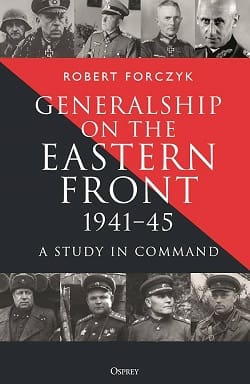
by Robert Forczyk.
Hardback (6.1×9.5 inches). 608 pages. 2026.
Subtitle: A Study in Command
This is a big book for a big topic — how well or poorly did the top German and Soviet commanders do during WWII on the Eastern Front. Each year receives a chapter, but each chapter gets divided up into specific operations. Each operation receives a recap and then an analysis of how the commander planned or responded to events.
A report card follows with a final conclusion about effectiveness or ineffectiveness using six criteria: Objective, Offensive, Mass, Maneuver, Surprise, and Security. Appendix 1 explains these six terms — something I would have put up front.
As the years roll by, various myths that had popped up in German memoirs and unchallenged due to a decided lack of Soviet information receive scrutiny.
One big difference between German and Soviet operational practice was German generally favored one big attack with all troops while the Soviets generally favored echelon waves of formation attacks (p39-41). Indeed, one strength of the Soviet system was creating huge strategic reserves of manpower with the idea of releasing the second and often third echelons of troops after the first echelon broke through. Or, for that matter, to counter German breakthroughs. The ability of the USSR to create and rebuild fronts time and time again was only slightly more amazing than German efforts to patch together a line using culled support troops.
The Soviets’ weakness was in logistics — they constantly ran out of ammo and fuel just as they cracked the German lines. Granted, the Soviets got better at it as the years passed, but only rarely did they plan ahead enough and assign enough support to make logistics a non-problem.
The casualties were enormous, especially for the Soviets. For example, in 1942, the Germans suffered 1.1 million casualties and lost 2,450 tanks. The Soviets suffered 7.35 million casualties and lost 13,000 tanks (p251). A rule of thumb is that about 1/4 to 1/3 of casualties were deaths or missing. In 1943, the Germans suffered 1.5 million casualties and lost 7,000 tanks. The Soviets suffered 7.85 million casualties and lost 22,400 tanks (p373).
These numbers really beg the question how tabletop wargames can match such ratios. This disparity of up to 10:1 depending on the operation continued until 1944, when the Germans suffered 2.8 million casualties (tank losses not listed). The Soviets suffered 6.8 million casualties and lost 23,700 tanks (p487). In 1945, the Soviets suffered 3.0 million casualties, but German casualties were not listed (p524).
Those are the aggregate numbers. Individual operations break down numbers and ratios within the context of how the commanders ordered their formations around. Just to be clear, this is high level: German corps and Armies are the norm versus Soviet Armies and Fronts.
One excellent reason for high Soviet losses resides in Stalin’s style of commanding. Commanders who suffered stinging reverses, especially those not of the inner circle of old comrades, were often jailed and/or executed. Commanders who did not follow the specific instructions of Stavka, not to mention the political officers assigned to them, suffered the same fate. Given the choice between ordering an ill-advised attack or arguing with a Stavka order to attack, the Soviet commanders attacked, prepared or not.
Of note, the Germans held a four-day wargame of Barbarossa that found escalating logistical problems. These results were ignored (p54). The Soviets held two wargames of a “Blue” invasion of “Red” USSR — Blue won both times under different commanders (p44).
The book contains 38 black and white photos and six somewhat basic black and white maps. The lack of maps is a significant weakness.
Ideally, one map should be included for every operation. I am not that familiar with USSR geography that I knew where each formation attacked and defended, not to mention remembering all the commander names. You’d think an Osprey Publications book would contain all the maps needed.
The analysis within certainly made me think about how wargames portray results. Europa at 16 miles to the hex, or maybe GMT’s line at about 5 miles to the hex, is probably the closest you’ll get to seeing a mass of counters develop into an attack. I recall at Tom Johnson’s Europa game at GenCon with the maps stretching from Normandy to Moscow and down to Sicily, back in the 1990s, he altered the Europa CRT and supply effects, and had his own counters printed, to showcase the overwhelming ratio of casualties. As I played , I was amazed that the Germans could hold off many times their number — for a while.
The map point aside, the book provides a significant contribution to understanding the command capabilities and performance on WWII’s Eastern Front. The report card offers a quick-hit numeric understanding of each commander in an operation — a bonus if you plan on assigning some sort of high command benefits or detriments to a tabletop scenario. Impressive book.
Enjoyed it.
— Reviewed by Russ Lockwood