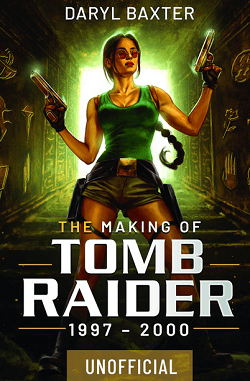
by Daryl Baxter.
Hardback (8.5×12.0 inches). 251 pages. 2026.
This is not the making of the movie, its sequel, or the reboot. The movies pop up on TV from time to time and I enjoy from time to time.
No, this is a history of the making of the video games for Playstation: Tomb Raider 3, TR4, and TR5. It’s mostly transcriptions of interviews from the principal programmers, level designers, voice-over actress, and others at Core, the company that produced the games about one every year. So, you basically can read the oral histories of the game makers.
I have never played any of them, so a lot of the discussions about particular levels and scenes is lost on me. But I did review computer games in the 1980s and 1990s for Creative Computing, A+, Personal Computing, Computer Shopper, PC Sources, and other various computer magazines as well as ran the ComputServe forum for Computer Gaming World back in the day.
What I did find fascinating was buried in all those interviews — was the time pressures and some of the tricks of the trade. Hidden “secrets” to uncover as you investigated the rooms that could be used as future triggers (like grabbing a key for later use), types of traps, and use of Full Motion Video (I call ’em cut scenes) to hide programming bugs.
They worked insane hours to design, program, and bug check their levels to meet a November deadline, presumably for December holiday sales. Bug checking was never long enough and the games shipped with occasionally notable glitches, but reviews and sales were good enough to do TR3 which led to TR4 and that led to TR5. Each version generally added more features, which required more sophisticated programming and caused no end of problems. Apparently, the kayak was a right royal pain. A big battle over TR5 required a variety of incentives to keep the team programming, but as the series was a cash cow, so it was produced. TR6 was started, but never produced.
All was not unicorns and rainbows: personnel issues with boredom, bonuses, and conflicts occurred. Sure, 25-30 years can generate a little bit of rose-colored memories, but it’s also obvious certain things still rankle.
The book contains 111 color game screen shots, 16 color photos, one black and white photo, 24 color storyboard illustrations, and 50 black and white storyboard illustrations.
The more familiar you are with TR3, TR4, and TR5, the more you’ll like this book. Yet even though I never played these particular games, I was fascinated at the detailed behind-the-scenes oral histories by many of the key makers of the games.
Enjoyed it.
— Reviewed by Russ Lockwood