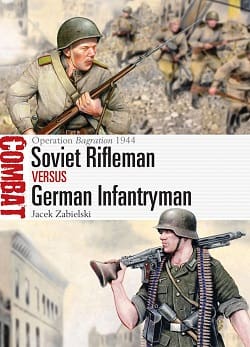
by Jacek Zabielski.
Softcover (7.25×9.75 inches). 96 pages. 2026.
Subtitle: Operation Bagration 1944
Operation Bagration caught the Germans out of position and the Soviets tore a strategic hole in the German front line during the summer of 1944. Not only did the Red Army have material and manpower superiority, it had learned the lessons of the art of maneuver and Stalin was giving his front commanders more leeway in directing the offensives.
Per usual, recruitment, training, and equipping of the troops is covered in depth, along with tactics and logistics. The German troops were still more than a match for the Soviets, but Soviet quantity was a quality all its own.
Three battles are covered: Vitebsk-Orsha (June 22-27, 1944), Minsk (June 27-July 7, 1944), and Vilnius (July 3-July 13, 1944). Breakthroughs and pincer movements, along with the command decisions directing the troops, receive ample description and analysis to highlight Soviet advances.
The TO&E of a typical German and Soviet infantry division (p78) is especially helpful in creating larger-scale scenarios where the base unit is a company. Or, with a little imagination, you can create a “bathtub” scenario where a small tabletop unit represents a larger historical unit.
Don’t confuse this title with German Infantryman vs Soviet Rifleman: Barbarossa 1941.
The booklet contains 50 black and white photos, four color uniform illustrations (front and back Soviet and front and back German infantry), four color maps, and three color two-page illustrations.
Altogether, a nice explanation of pros and cons of each side’s soldiers.
Enjoyed it.
— Reviewed by Russ Lockwood