.
.
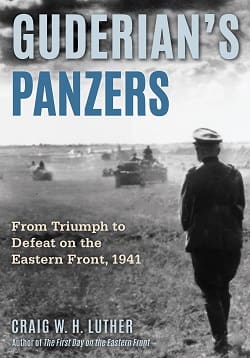
by Craig W. H. Luther.
Hardback (6.3×9.3 inches). 401 pages. 2025.
Subtitle: From Triumph to Defeat on the Eastern Front 1941
This profile of Guderian’s 2nd Panzer Group during Barbarossa offers a marvelous operational history of the Group’s actions from June to December 1941.
The praise for Guderian’s leadership comes as fast and furious as his advance deep into the Soviet defenses. Time and again, he drove his steadily eroding divisions into and through Soviet units, preventing defensive lines from forming. The first two months proved to be Blitzkrieg at its finest and this book explains how it was done and the decisions Guderian made to enhance the offensive.
On the flip side, Guderian could be exasperating to deal with and often used his own initiative to disobey direct orders. Mostly, his instincts were good, but sometimes, not so much. His decision to drive on and not close the pocket in Smolensk allowed 100,000 Soviet soldiers to escape and form the cadre of future units (p72).
At times, his units were so far in the rear of Soviet defenses, the “advanced supply depot” was 400km behind them and railheads were 750km behind them (p80). Yet he drove them onward despite fuel, ammo, and spare parts shortages and few replacement troops.
He opposed the turn to the south to close the Kiev pocket — a pocket shaped like a triangle that measured roughly 500km on a side. Luftwaffe attacks had to be used to compress and eliminate the pocket (p164). Despite the bagging of prisoners and material, his focus remained on Moscow.
Operation Typhoon started with his units at roughly 75% strength compared to June 22, 1941 (p196). Shortages of ammo, fuel, replacement troops, and parts had still not been resolved, but he started the drive to Moscow nonetheless. Railroads converted from the USSR standard 1528mm wide to German 1435mm moved slowly — about 10km to 12km per day — despite the number of specialty RR units used (p118).
By Nov. 6, 1941, the combat power of a German panzer division was only 35% of its paper TO&E strength (p272). Yet from June to December, the USSR mobilized 285 Infantry Divisions, 88 Cavalry Divisions, 12 Tank Divisions, 93 Tank brigades, and 174 rifle brigades (p364). Long odds indeed to reach Moscow as wargamers know.
The book contains 105 black and white photos, three black and white maps, and eight color period maps.
Long ago, Mark, Tibor and I played Drang Nach Osten, GDW’s division-level (with lots of brigades, regiments, and even some battalions) wargame of Operation Barbarossa. It took us a long time, but we had the time and the space to leave everything set up turn after turn. We each played a German Army Group, and then when we put on our Soviet hats, we swapped spots so that we could play against someone other than ourself.
By dint of a fortuitous discovery of a weak part in the Soviet line, I managed to open up a corridor and several panzer divisions and support units smashed into four of the seven hexes of Moscow — including the all-important center hex. I burned the factory, shot Stalin and Stavka, and waited for the inevitable counter-attack. I lost most of the panzer divisions and was kicked out of Moscow. Funny, the war went on nonetheless across the hex grid.
We also once played in a massive play-by-mail game with teams. I was a Soviet and had about a 20-hex front in/near the Valdai Hills. Here are your troops – position as you see fit. Great fun at first, except Stavka increasingly fiddled with commanders’ units. It makes sense – I didn’t know what was going on elsewhere, so when Stavka went looking for units to shore up their overall line, out some came from my force and my carefully considered deployment was re-jiggered. Alas, more and more of Stavka micro-managing took the fun out of crafting a line with what you got. What’s the point of positioning units if they’re all going to be re-jiggered? Now, if you told me at the start of the turn I would need to send off a few units, that would be different. I don’t remember how it ended, but it was chronicled in a newsletter.
Reading this well-written book makes we want to pull out Scorched Earth (upgraded version of DNO) once again. Even with the thousands of counters in DNO/SE and a map that stretches across a ping-pong table, it’s difficult to duplicate what Guderian’s 2nd Panzer Group (later 2nd Panzer Army) did in those six months. This book explains why. Brilliant.
Enjoyed it.
— Reviewed by Russ Lockwood