.
.
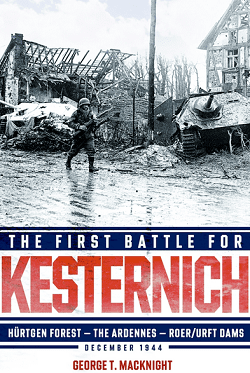
by George T. MacKnight.
Hardback (7.0×9.9 inches). 352 pages. 2026.
Subtitle: Hurtgen Forest — The Ardennes — Roer/Urft Dams
Despite the title, the action begins in September as the US 78th Division attacked into the Hurtgen Forest just before the Battle of the Bulge. The unit was eventually ordered to take Kesternich, an important crossroads town on a plateau that also overlooked a number of Roer River dams. At first, both sides didn’t recognize the importance of the dams, but releasing the waters would flood the valley and make for a difficult to impossible crossing downstream.
This hypertactical examination of the US attack through the nightmare terrain of the Forest, up the sides of the plateau, and into the town itself presents immense detail. In general, it takes you from the regiment level down through battalions, companies, platoons, sections, and individual soldiers.
Better yet, and I can’t give enough kudos, the book includes not only US Army maps (I’m eyeballing at 1:25,000 scale) with colored arrows for attacks AND successive time lines through the progression of these 13 maps, but well-marked aerial photos of the area attacked by US troops. Excuse me, I just drooled on the book at the wargame scenarios you can pull from this. Pair these with the detailed terrain descriptions (p47 a must read) to adjust your scenarios.
Before I hyperventilate myself into unconsciousness in praise, allow me to point out that this includes lots and lots and lots of first-person accounts — mostly taken from the 78th Division magazine The Flash. Some go on in tiny type for more than a page. Individually, they offer a foxhole-eye view of situations and actions. Yet, I find they get repetitious as you continuously read about soldiers being cold, confused, and taking/giving fire. Just because you found them doesn’t mean you have to put all of them in the text. Well-written narratives will weave the general sense of perception with the pinpointed anecdotes far more effectively than an info dump. To me, these type of accounts are like spice: use ’em but don’t abuse ’em.
I know MacKnight can do this: his concise description of the replacement system, and more importantly, the effect it had on division effectiveness (p272) is well done. A tip of the electron to the explanation of US pre-plotted artillery fire and the specific map (p206), although I would have liked to know a little more about the time frame needed to scout the locations, or, presumably, use maps and aerial photos to select the zones. The bibliography lists the original artillery source manual if I need more info, but under combat conditions?
A few non-fatal typos: 600 yards is not 54 meters and 300 yards is not 27 meters (p24), so both meters are missing a zero; “a Jagdpanzer 3812” needs the “12” deleted; and a format error (p330) in the bibliography.
The book contains 105 black and white photos, 10 black and white maps, 14 color maps, and one black and white illustration (bunker layout).
Here’s a tactical battle done right and done well.
Enjoyed it.
— Reviewed by Russ Lockwood