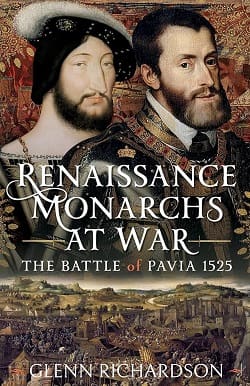
by Glenn Richardson
Hardback (6.4×9.5 inches). 244 pages. 2025.
French King Francis I and Holy Roman Empire Emperor Charles V battled for control of Italy, especially Northern Italy and the strategic city of Milan. This history starts further back than 1525 as Francis staked a claim to the Kingdom of Naples in Southern Italy.
A rather interesting synopsis of royal intrigues, especially the intertwining of families and the interventions of various popes, leads off Francis’ expedition to the south of Italy. A truly tangled web of diplomacy, claims, counter-claims, invasions, and counter-invasions receive ample explanation.
Francis’ artillery train proved to be the early deciding factor. It blasted open fortresses and cities so effectively, after the first few conquests and pillaging, many surrendered without firing a shot. When combined with pike and cavalry, it was equally effective on the battlefield. Naples soon fell.
Charles, who was in charge of roughly Germany, Netherlands, and Spain, also invaded Italy and so began the early 1500s Italian wars that also included Henry VIII of England. The Ottomans and the Austrians also influence the course of events, via allegiances and military threats, that eventually led to the 1525 Battle of Pavia.
The various battles, including Pavia, receive nice overviews and examinations of the consequences. Pavia gets a trio of maps that should allow you to set up scenario terrain. The biggest problem is that the maps have no scale — how could include a map without a scale is beyond me.
Incidentally, GM Martyn Kelly offered the definitive miniatures scenario of Pavia at Historicon 2025. You can supplement the maps by finding photos or videos of his magnificent creation that won the Best of Show award.
One typo: “August1521” (p63) needs a space.
The book contains six black and white photos, 25 black and white illustrations, and three black and white maps.
The dynastic struggles of the early 1500s can be difficult to follow, but this book does a good job of providing an overview.
Enjoyed it.
— Reviewed by Russ Lockwood