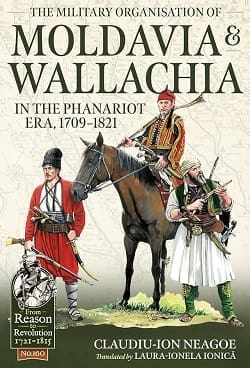
by Claudiu-Ion Neagoe.
Translated by Laura-Ionela Ionica. Softcover (6.1×9.2 inches). 220 pages. 2026.
Subtitle: From Reason to Revolution 1721-1815 No. 160
I don’t know if it is only this book or the series in general, but the format shrunk, from 6.7×9.7 inches to 6.1×9.2 inches. Size shrinkflation probably goes along with the trend towards smaller fonts in the book industry. Then again, sometimes the 19th century books I read contain smaller fonts than current sizes. Maybe it’s a case of what goes around comes around?
In any case, your word for the day is “phanariot” — essentially an Ottoman-appointed governor of the regions of Moldavia and Wallachia. For a time, these governors were selected from among the Greeks inhabiting the Pharar district of Istanbul. Man, I love reading history — you learn something new every day.
Said phanariots were sometimes conscientious, sometimes licentious, sometimes brutal, and sometimes incompetent, but they made sure these provinces toed the Ottoman line. It wasn’t always easy. The Moldavians and Wallachians were independence minded and their soldiers often defected to Ottoman enemies. Apparently, it happened so often, the Ottomans took away their weaponry and turned them into construction troops.
In any case, the book offers short unit histories of an awful lot of units — all with terms, names, and other spelling designed to make the heads spin of English-centric readers like me. Most of these units, one chapter of Moldavian and one of Wallachian, numbered no more than 50 troopers or infantry, but the unit histories cover a multitude of types, including OOBs and uniform colors.
The book contains 36 black and white illustrations, three black and white photos, and two black and white maps. A center section contains seven infantry and three cavalry color uniform illustrations.
I can’t say I read every word on every page. After 50 or 75 units, the words started to blur. It’s great information if you are building a Moldavian or Wallachian army and want to see how specific unit types fit into the whole, but it’s a tad dry. It’s more resource than page turner, although the beginning chapter tracing the history of the phanariots and their units reads much smoother than the later short unit histories.
If 18th century Moldavia and Wallachia is your area of interest, this book covers the military angle. And for that, ties go to the author.
Enjoyed it.
— Reviewed by Russ Lockwood