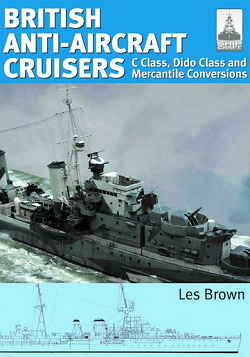
by Les Brown.
Softcover (8.25×11.7 inches). 64 pages. 2026.
Subtitle: C Class, D Class and Mercantile Conversions
As WWII progressed, the British increased the anti-aircraft armament on their ships in the face of Luftwaffe attacks. They eventually modified certain ships into AA-intensive ships to help protect convoys.
The C Class were mostly cruisers built during WWI and modified to support more AA guns. Each of the ship gets a short history, including refits and fate. Indeed, a lot of C Class cruisers were sunk.
The D Class and merchant ship conversions were part of interwar and WWII construction, with WWII AA modifications. Those also receive a short history and fate.
As usual in the series, pages 1 to 16 and 49 to 55 offer history and the rest is given over to modeling. Pages 17 to 24 cover model products, including lots of 3D-printed items. Pages 25 to 44 show eight finished plastic models created by masters with serious patience and skill sets. Four are in 1:350 scale and four in 1:700 scale.
Pages 44 to 48 provide color camouflage profiles for specific ships, pages 56 to 58 provide text descriptions of color camouflage patterns for specific ships, pages 59 to 63 provide top and side profile drawings for specific ships, although without listing a scale, and page 64 lists manufacturer web sites and the bibliography.
Now, to be clear, this is not a step-by-step instruction to make great models. It showcases what can be achieved with plastic model kits and aftermarket options.
The booklet contains 37 black and white photos, 43 color photos of model products and box art, 69 color photos of eight models completed by master craftsmen, 18 historical color camouflage patterns, and 28 black and white drawings of the tops and sides of various ships.
It’s another fine addition to the series, and more so if you put together plastic WWII ship models.
Enjoyed it.
— Reviewed by Russ Lockwood