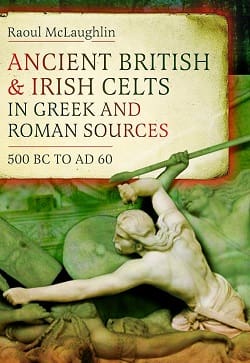
by Raoul McLaughlin
Hardback (6.4×9.4 inches). 201 pages. 2026.
Subtitle: 500 BC to AD 60
Another nice consolidation of ancient sources translated into English, this time centering on ancient Britain and Ireland. The usual main suspects are represented — Julius Caesar, Tacitus, Strabo, and Cassius Dio, for example — but more obscure references are included as well.
I rather enjoyed the voyage of Pytheus of Massalia (modern day Marseilles) from 325BS to 324 BC, who dodged Carthaginian ships on his way past the Pillars of Hercules (Gibraltar) and sailed up the Celtic (French) coast and out to Britannia’s south coast and around modern-day Cornwall. Then, he went up the west coast of Britain (facing Ireland) and around the northern top to Thule.
Thule seems still a bit of a conundrum — it could be the modern-day Orkneys, Faroe Islands, or even Iceland. In any case, he completed the circumnavigation of Britain and headed east along the coast, up and around modern-day Denmark and perhaps as far as the Eastern Baltic around Lithuania or Latvia. Then he returned to Massalia.
The rest will depend on how much you’ve read the classics of ancient sources. If you’ve read the main suspects, little will be new. If not, then much will be new.
A note on pay: average unskilled laborer in Imperial Roman times received four sesterces for a day’s work (p56). A Roman legion cost 11 million sesterces per year (p39). With 30 to 33 legions, that’s a lot of sesterces as a defense expenditure (not to mention the navy).
The book contains four black and white maps and 83 color photos (68 of period coins — 34 obverse and 34 reverse sides).
I’m not quite sure what you can glean for tabletop scenarios, but it may inspire you to read the full versions of the period sources. The explorations of Pytheus might make for an interesting scenario as some sort of Eurogame. It’s good to read translations about a concentrated geographic area, so ties go to the author.
Enjoyed it.
— Reviewed by Russ Lockwood