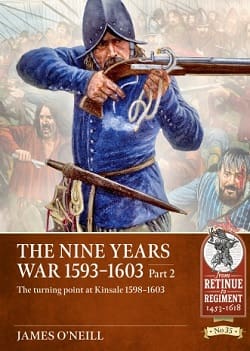
by James O’Neill
Softcover (7.2×9.8 inches). 203 pages. 2026.
Subtitle: The Turning Point at Kinsale 1598-1603
Subtitle: From Retinue to Regiment No. 35
Well-written account of the Irish rebellion against England complete with a multitude of skirmishes that ultimately led to the Battle of Kinsdale as the English defeated an uncoordinated Irish-Spanish force.
The Irish fielded 500 men and fewer in just about all the skirmishes, but they made extensive use of their mobility and knowledge of the land to ambush English raids. The English commanders appointed by Elizabeth I proved mostly inept until Mountjoy, who took pains to shore up his logistics before launching raids, capturing and fortifying castles, slaughtering the Irish they found, and burning Irish crops and homes. A little bribery didn’t hurt, either.
The Irish finally convinced the Spanish to send a fleet and army, but storms scattered the fleet and only a few thousand troops landed in and around Kinsale in southern Ireland. The English sealed in the Spanish and the Irish marched to break the siege. The big battle of the campaign pitted less than 5,000 troops per side.
Of note, England’s debasement of its own coinage served to reduce Irish purchases of overseas weapons and munitions (p97-98) — an unusual, if effective strategy.
The book contains 10 black and white photos, 21 black and white illustrations, eight color uniform illustrations, and 41 black and white maps — the vast majority being period maps. Bravo for supplying so many maps, admittedly somewhat hard to read and often without a scale, but an excellent starting point for laying out a tabletop for a skirmish.
Filled with details, this Part 2 offers a fine look at the back half of the English campaign to suppress the Irish revolt. Despite the size and resource difference, the campaign could have gone either way. Well done.
From Retinue to Regiment No. 29 is Part 1 of the Nine Years War. A number of the From Retinue to Regiment series volumes covers Elizabethan warfare, notably the three volumes of The Tudor Arte of Warre.
Enjoyed it.
— Reviewed by Russ Lockwood