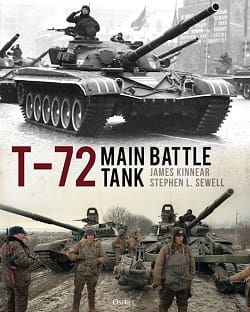
by James Kinnear and Stephen L. Sewell
Hardback (8.0×10.0 inches). 320 pages. 2026.
This wide-ranging profile of the T-72 tank covers design, development, and deployment of the tank and all its variations, as well as derivative versions such as engineering, bridge-laying, mine-clearing, recovery, artillery, and flamethrower versions. Chapters are dedicated to export versions, museum tanks, excerpts from manuals, photo-heavy walkaround, and combat operations.
As you might expect, specs and technical details predominate. Combat is relatively lightly done save for the Iran-Iraq War, Chechnya, and some of the Gulf War.
Of interest: In Chechnya, after horrendous losses from urban ambushes, the Soviets developed the “Fire Carousel” tactic — first tank covers the infantry with firing 22 rounds (the limit of the auto-loader) and pulls back to be replaced with the second tank, which fires 22 rounds and pulls back. The third tank moves up and fires 22 rounds and pulls back. By this time, the first tank has completed the laborious 20-minute re-load of the auto loader and the “carousel” starts anew. Because the thick frontal armor is facing the enemy, flank shots are fewer and thus fewer losses (p184).
Another note: The T-90 tank of the 1990s was really an upgrade of the T-72BU version. The new designation was meant to represent a new democratic phase in Russian armor (p50).
One typo: “agreed a ceasefire” (P175) should have a “to” inserted.
The book contains 521 color photos, 92 black and white photos, 27 black and white images, and six color camouflage profiles.
I tended to skip around while reading the specs of version after version, but true T-72 treadheads will rejoice at the detail. All those color photo close-ups of various parts and systems will be of value to modelers.
Enjoyed it.
— Reviewed by Russ Lockwood