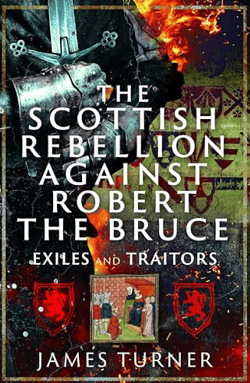
by James Turner
Hardback (6.5×9.5 inches). 247 pages. 2026.
This book starts long before 1314 with an examination of the intricate intertwining of English and Scottish aristocracy. A plethora of this noble, son or daughter of that noble, cousin to another noble populate the first third of the book or so. After your brain can no longer remember which William or Robert was which, you sort of want to yell, “Get on with it.” And yet, without the “related” background, it would be hard to understand the scheming the families put into power grabs.
And then there’s Edward I’s insistence on being recognized as overlord. When John Balliol was finally crowned King of Scotland (p65), Edward I had sown dissent to get him elected, which was used as leverage to be recognized as overlord. As the text notes, it was less nationhood and more family prominence and bribery. John Balliol topped Robert the Bruce and 11 other nobles to be king, but his hold on the crown was precarious.
In the politics and warfare that followed, Robert the Bruce came out on top, vanquishing the rival Comyn and Balliol families and defeating Edward I at Bannockburn in 1314. That led to Edward abandoning claims to Scotland, returning regalia, and signing a treaty. Treaties seem to be worth as much as the military force and political obedience can offer.
Enter the Disinherited, a group of Scottish and English nobles who refused to call Robert the Bruce king and had their lands confiscated. They raised an army of 1,000 bowmen and 500 men-at-arms (p156-157) to take it back with a sea invasion in 1332. And that is the last half of the book.
A couple shortcomings: no map. I’m sure William, Lord Ferrers of Groby (p148), is a famous Grobian from the famous town of Groby, but it’d be nice to see where that is. About 35 years ago, I rented a car for a two-week meandering, circular, driving trip around Scotland, so I have a notion of places like Edinburgh, Perth, Inverness, Loch Ness, Mallaig, Glenfinnan, Glasgow, Dumfries, Hadrian’s Wall (OK, that’s Britain), Jedburgh, St. Abb’s Head, Roslyn Chapel, and back. Groby? Google Maps sez: It’s near Leicester off the M1. Unless there’s another one. Lots of place names are referenced, but unless you are a Scottish geography whisperer, hard to figure out where everything is.
Second, a few terms needed definitions. Shrievalthy? A Sheriff is assigned to what I think is a geographical area. How about this sentence: Celtic tanistry system in which an heir was selected from the king’s surviving agnatic relatives (p62). Thanages (p78)?
Some typos: “Dived between multiple heirs” (p60) is perhaps “divided” or is that another term?; “barley 1,500 men strong” (p. vi) is likely “barely”; and John was crowned King of Scotland in 1192 (p 71) but the other references are for 1292.
The book contains no maps, photos, or images.
The tangled web of family connections made my head spin until I was almost ready to toss it, but I figured there was a point to it. And there was. If you can grind your way through it, you’ll find an interesting account of aristocratic greed and sense of entitlement that led to a little-known campaign. Ties go to the author.
Enjoyed it.
— Reviewed by Russ Lockwood