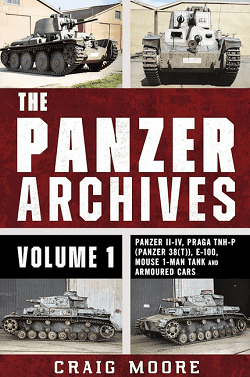
by Craig Moore
Hardback (7.0×10.0 inches). 182 pages. 2026.
Subtitle: Panzer II-IV, Praga TNH-P (Panzer 38(t)), E-100, Mouse 1-Man Tank and Armored Cars
The subtitle lists most of the tanks, each with its own chapter, but doesn’t include Wire-Mesh Skirting on German Tanks. The PzIII is covered under Poison Gas Bullet Attack on a Panzer III. The Armored Cars are Fiat Ansaldo Autoblinde AB 41 Italian Armored Car Trials, Wilton-Fijenood Panserwagen Armored Car (Netherlands), and Schildkrote Panzerspahwagen Light Amphibious Turtle Armored Car. The Praga is a pre-war Czech tank the Czechoslovakians tried to sell to the British and sent a tank and a team to demonstrate its abilities.
Treadheads will love these reports by the British engineers, who dissected each of the vehicles and put them through field tests. Their evaluations examined the tech specs and the practical use. It’s all listed and described in various sections like armor, suspension, interior, transmission, etc. etc. etc.
I discovered the side skirts on German tanks were not designed to stop PIATs and bazookas, but were designed to stop Soviet 14.5mm anti-tank bullets from penetrating the side armor. The mesh was just about as effective, but lighter, allowed better views, and branches could be stuck into the screen for camouflage (p84).
I’ve read about the 100-ton E-100 tank before, but the one-man 2.7-ton Mouse tankette was new. Only plans are printed because it was rejected by the Germans and never went into prototype format. Its twin guns in the hull stuck out in front, which could have caused the barrels to dig into dirt if a steep enough descent into a shell crater or bottom of a hill.
Of note is that the Wilton-Fijenood Panserwagen Armored Car used foot-powered bicycle pedals to rotate the turret (p160 with interior photo p164).
The Turtle armored car generated a couple prototypes, but these uncovered a number of problems, so the Turtle was never put into production.
One typo “infront” (p74) needs a space.
The book contains 167 black and white photos and 17 black and white illustrations. The British engineers were thorough in photographing vehicles and subsystems. The E-100 was photographed in its assembly building by the US Army.
Note that this is only the first volume. It didn’t say how many more will follow — maybe that depends on sales.
I can’t say I read every word of every technical report reproduced in the book, but I paid more attention to the vehicles was not or less familiar with. Although the more general reader will find the reports and commentary a bit overwhelming, technical enthusiasts will revel in the technical revelations. For that, I’ll say ties go to the author.
Enjoyed it.
— Reviewed by Russ Lockwood