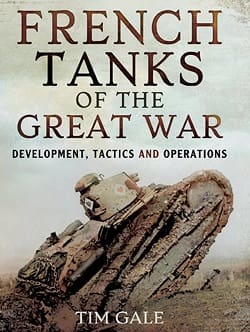
by Tim Gale
Softcover (6.2×9.3 inches). 268 pages. 2026 reprint of 2016 book.
Subtitle: Development, Tactics and Operations
The three main tanks used by the French — St. Chamond, Schneider, and Renault — receive the bulk of the attention, but a few experimental tanks are included as well. Lots of tank actions are covered, although most follow the general of some break down on the way to battle, some ditch and bog down during battle, some destroyed by German artillery, and the few remaining tanks destroy lots of machine gun nests. The supporting infantry may or may not keep up, which determines when the tanks withdraw for resupply or repair. For example, during the Malmaison battle, two-thirds of tanks broke down before reaching the first trench line (p73).
In general, each battle receives a comprehensive look at the situation and goals, planning and preparation, combats that often include single tanks, and lessons learned from each battle. It’s a nice, logical and effective way to learn about the evolution of French tank warfare.
Initial tank formations were 200 meters per four-tank battery, with 800m to 1,000m frontage for the four-battery groupe (p20). New to me was the conversion of some tanks to be mobile supply and repair shops and a couple converted to be wireless telegraphy tanks (p63).
Of note that during the 1917 Nivelle Offensive, Bavarian divisions deployed four battalions in the first trench line, two battalions in the second line, and three battalions in reserve which could quickly occupy the third line or provide counter-attacking forces. In between the lines were machine gun nests with interlocking fields of fire. A distance of two to three kilometers were between these lines with about a 7km overall depth per division (p20).
One possible typo: “1 CA” or “11 CA” (p118) could be two separate adjacent corps or just a typo — not sure which.
The book contains 16 black and white photos, seven black and white illustrations, and five black and white maps. The appendices contain tech specs and a long chart of tank battles.
You’ll need more map and OOB information to make a proper tabletop scenario, but for an introduction and analysis of WWI tank warfare, this is a fine examination of French operations.
Enjoyed it.
— Reviewed by Russ Lockwood