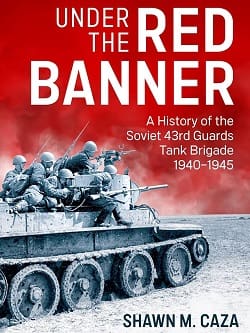
by Shawn M. Caza
Hardback (6.8×9.9 inches). 222 pages. 2026.
Subtitle: A History of the 43rd Guards Tank Brigade 1940-1945
As I read this, I kept thinking of the Europa wargame and its Soviet 2-1-8 tank brigades. I can’t remember if the Guards designation added any factors or if the factors changed much when the brigade evolved from T-60/70 and T-34 regiments with a mechanized regiment to late-war IS-2 and SU-152 regiments. I do know you will be exceptionally pleased with understanding how tank brigades were created, deployed, and used as well as how they evolved over the course of the war.
The 43rd started life as the regular 145th Brigade with a mix of light tanks, medium tanks, and motorized infantry with minimal engineer and other support elements. Indeed, that minimal support often proved an impediment to successful offensive actions.
Every move of this unit, from little village to little village, is covered, as is every combat — from the entire unit to individual tanks. Most histories leave me at a loss to know where these villages are located, but lo and behold, pieces of period maps are reproduced for almost every march and battle. Better yet, they are mostly located on the page or the opposite page so you can actually find these villages.
This is exactly the treatment I applaud. Sure, some of the maps are better reproduced than others and you have to squint to pick out terrain details, but a magnifying glass helps you develop the map into terrain on a tabletop. Bravo!
Indeed, Caza might be a wargamer, for he includes OOB, TO&E, march rates, deployment distances, and other details for scenario building.
The brigade was made up of three regiments, or battalions in US lingo: two tank (KV1s, T-60/70s, and T-34s until late war) and one motorized infantry. It’ll be hard for those used to hub-to-hub models to get used to the actual attack and defense distances.
For example, a typical attack has recon and first battalion (at least three infantry companies) about 1km ahead of the main force and about 800m in depth. Behind, the main force has the T-34 battalion of three companies in line abreast formation with tank riders and at least two companies of motorized infantry — about 600m in depth. The last force has the HQ and support troops plus one T-34 platoon. Call the whole deployment depth about 2km or so. The Brigade on the march stretched over 7km in depth (p193) in early war or 10km to 11km in depth (p366) as the war continued.
Tank reliability was horrible for KV-1s and T-34s with up to 50% breakdown rate on a 58km march, but much better for T-60s and T-70s (p216). The brigade was deployed for combat 34% of the time during the war years. The other 66% was spent in training and rebuilding. With these details and more, it seems like each T-34 and KV-1 tank should roll for a 50-50 chance of being disabled.
The unit had been eliminated a couple times during 1941 — had so few tanks and troops left that tanks were transferred to another brigade and the surviving crews pulled back to reconstitute the brigade.
The tank brigades were subordinate to the rifle divisions, which never knew if they would be transferred or not, so division commanders tended to send in the brigade regardless of situation because they were counted only as temporary assets. As training in the early was minimal and the tactical acumen of commanders even worse, these brigades took horrendous losses. Between August 4 and October 4, 1941 the unit lost 140 tanks (including seven captured German trophy tanks and one British Valentine. The unit was constantly incorporating new tanks from the factory and transferred tanks from other brigades (p123). Note that the official full strength was eight KV-1s, 20 T-34s, and 20 T-60/T-70s (p116). Like German units, it hardly ever had its full complement.
A couple typos: “outrun be German land elements” (p74) should be “by” and “on T-34” (p107) should be “one.”
I admit I neglected to count the images and maps: my estimate is a couple hundred sections. I can say that there was a switch from photos of period maps to reproducing black and white illustrations of maps. Either way, lotsa maps.
Impressive unit history with the touches needed to create tabletop scenarios. You’ll need German sources for the scenarios, which is easier to access than Soviet sources. As info comes mostly from Soviet records, you do have to take some descriptions and official returns with a bit of skepticism. The 145th/43rd Guards may have exaggerated a wee bit about German casualties. It is interesting to note that Soviet losses were horrendous and many sub-units fell to under 50% of official strength.
It reads well for such a detailed work. The info within is impressive. It’s got maps. Excellent!
Enjoyed it.
— Reviewed by Russ Lockwood