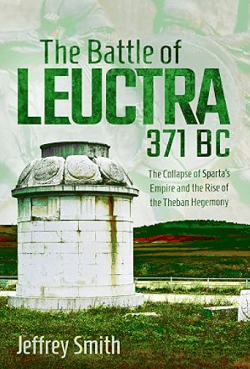
by Jeffrey Smith
Hardback (6.4×9.5 inches). 218 pages. 2026.
Subtitle: The Collapse of Sparta’s Empire and the Rise of the Theban Hegemony
Most references to Sparta refer to Thermopylae first, then to the Peloponnesian War second, but after Sparta defeated Athens in the latter, the city state built an empire based on military prowess and oppression. Ultimately, a slow loss of Spartiates over the decades created a dwindling number of Spartan hoplites. That in turn led conquered city states — not to mention the slave helots — to rebel, locking Sparta in never-ending warfare that led to Thebes and its Boeotian allies to finally amass enough troops to challenge the Spartans in open battle. It helped that two excellent Theban commanders — Pelopidas and Epaminondas — organized and led the army.
Before you get to the actual battle, a full history of the creation of the Spartan empire offers needed background. Some of this will be familiar, but much of this new. Of note, Sparta only kept garrisons in a few key city states, Thebes among them, and relied on military reputation, and subjugation, to keep the populace of most city states in line. New to me was that the hoplite shortage got so bad, non-Spartan citizens were allowed into the ranks and at one point, a small rebellion was not brutally crushed and the villagers slaughtered, but King Agesilaus essentially pardoned most of them. How times changed.
Anyway, as the decades passed, Spartan leaders became sloppy and many garrisons were lost in surprise uprisings. So Thebans recovered their city state, created an army, and marched out to meet the Spartan Army at Leuctra. The short version is that Epaminondas increased the depth of the phalanx, put the best troops on the left side instead the right, inserted Pelopidas’ elite Sacred Band among these left troops, and used an oblique approach to allow his left to overwhelm the Spartan right. The long version you’ll find in the text.
The book contains one black and white photo, two black and white illustrations, five basic black and white Leuctra battle diagrams, one basic black and white Tegyra battle diagram, two black and white maps, 14 color photos, and one color illustration.
It’s well written and explains the workings of the Spartan empire and its opponents in detail using historical accounts and extrapolated analysis. The actual battle is covered in about 20 pages, but here’s a rare case where the 140-page preamble provides essential information about why Leuctra was more important and had longer-lasting effects than previous anti-Spartan battles. Well done.
Enjoyed it.
— Reviewed by Russ Lockwood