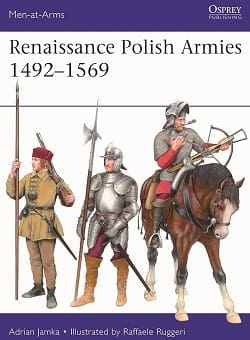
by Adrian Jamka.
Softcover (7.25×9.75 inches). 56 pages. 2026.
It didn’t take long for me to learn a new word when I ran across “rota was lustrated” (p6). A rota is a unit, but I looked up lustrated: Oxford Languages dictionary sez: “purify by expiatory sacrifice, ceremonial washing, or some other ritual action.” Learn something new every day.
The usual excellent MAA overview examines the selected Polish troops, starting with organization — the rota, for example. Then comes weapons, armor, and equipment of the various infantry and cavalry units. Finally, a look at the tactics and strategy of their use, and how well they did in battles and campaigns, concludes the overview.
During this time, firearms began to be more common, although the crossbow seemed to retain its popularity. A mounted crossbowman could span and reload in 15 seconds using a goat’s foot lever (p20). The text does not specify the reloading time of an arquebusier soldier, but does not an infantry unit would use a type of volley fire so the front rank would presumably be reloaded by the time the rear-most rank fired.
It took up to three months to mobilize an army (p37), which would march 10 km to 25 km per day, depending on the type of terrain (p38).
Per usual, the center section color illustration plates will certainly help anyone painting up a Polish Renaissance army. The eight pages of color plates contain 10 infantry and 15 cavalry figures.
The booklet also contains 21 color photos, one black and white illustration, 11 color illustrations, one color map, and the uniform illustrations.
It’s another excellent MAA volume.
Enjoyed it.
— Reviewed by Russ Lockwood