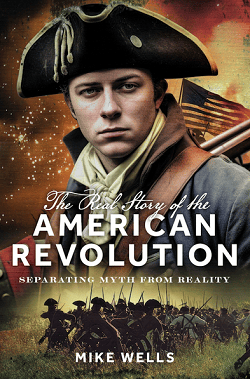
by Mike Wells
Hardback (6.3×9.5 inches). 198 pages. 2026.
Subtitle: Separating Myth From Reality
Pardon my skepticism about something with “real story” in the title. It sounds like one of those History Channel productions that purport to investigate history and end up tossing speculations against a screen and seeing what sticks.
But, since I find there’s nothing new like history, it was worth a read. Yet as I read, this examination of “alternative perceptions of some accepted narratives” (p. vi) skipped around with few references. Indeed, this book lacks a bibliography.
And that turned my skepticism into suspicion. It seems to me like a flitting around the internet and seeing what sticks. The American mob mentality of anti-tax protests is well known: attacking tax collectors and their property being prime examples, or the Boston Massacre started by protesters threatening a single British sentry, who called for help and got a squad of Redcoats and a discharge of muskets. The British did spend a fortune defending the colonies from the French during the Seven Years War (French & Indian War in the US) and the British Parliament wanted to raise taxes. The Americans were wealthy and a small tax on stamps, tea, and such wouldn’t hurt such prosperity.
One Intolerable Act I had not known much about was the Quebec Act, which guaranteed tolerance for Catholicism and extended Quebec territory down into the west of the colonies’ territory. Land speculators, George Washington included, found this blockage of a colonial version of manifest destiny, not to mention being subject to British courts instead of colonial courts, intolerable.
As the Revolution unfolds, American militia joined or left as they pleased and the Continental soldiers should be considered mercenaries, for contract limits and bonuses for signing up proved greater than any patriotism. Patriots and Loyalists engaged in a un-civil war involving kidnappings, murders, and property confiscation and destruction.
I forgot to note the page with Molly Pitcher, but the book also lacks an index.
In a sense, this is less myth-busting than a shallow skip through history. I don’t know if this is some sort of AI-generated smash and grab, but it is certainly one of the sloppiest text in a book I’ve seen in a while:
“British troops turfing honest citizens out of house and home” (p66) is likely “turning”; “instal” (p68) should be “install”; “granted or nor granted” (p73) should be “not”; “troops. faced with” (p95) should have a comma, not period; “captain” (p107) missing a period at end of sentence; “killed two British officer” (p188) needs an “s” and a period; and another missing period (p188).
The book contains eight black and white photos, 15 black and white illustrations, and one black and white map.
This book seems like a rushed job that was sold on a concept, “researched” via internet search or AI, and cut and pasted together with haste. We all need to learn more about our past so we can indeed separate propaganda myth from historical reality. For a general history of Revolution “myth from reality,” you may be better off with a more balanced history of “eighteenth century life and attitudes” with more bibliography and less casual searching.
— Reviewed by Russ Lockwood