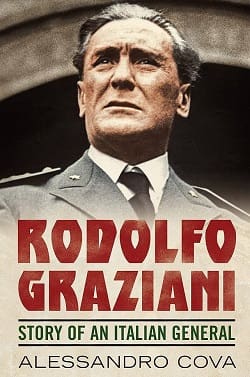
by Alessandro Cova
Translated by James Cetrullo. Hardback (6.4×9.4 inches). 255 pages. 2021 translation of 2019 reprint of 1987 book.
This biography jumps around in time, starting with Graziani’s 1940 offensive into Egypt and subsequent devastating British counterattack. Mussolini’s decision to enter WWII to get a seat at the victory table backfired for lack of a suitably equipped military. On June 10, the paper-strength “eight million bayonets” of the Italian Army was actually 1.3 million and some of the existing divisions lacked up to 92% of TO&E equipment (p14-15).
Indeed, as Graziani was chief of staff of the Army from November 1, 1939 on, he had sent a 121-page memorandum outlining all the shortcomings of the Army. Mussolini replied not to worry, the war will be a naval-aerial war and the Army won’t do much (p15). Graziani’s downfall after his desert debacle was swift.
For a while prior, he was the hero of the Italian colonies. His victorious exploits between the world wars in Libya and Ethiopia against even worse-armed natives garnered accolades and promotions. He had also served in WWI as well, surviving where others had not.
As for the book, while interesting because I knew little about Graziani, the use of page after page after page of period telegrams didn’t thrill me. Sure, it showcased his mental state, but I don’t need an info dump of an archive, I need an analysis of that info. To my mind, excerpts should be used sparingly to add impact to an analysis, not just show a descent into the archive.
For example, picking out telegrams and report excerpts about the use of poison gas against the natives proved to be powerful evidence against those who would deny such use.
Graziani ultimately ended up the Army chief of the RSI — Mussolini’s puppet government set up by the Nazis after freeing him from Allied capture. Like many an Axis general during the post-WWII Cold War, Marshal Graziani was tried, delayed, tried, shuffled to a military court, convicted of what he had already said he did, and sentenced to time served. In 1950, he was free to go and try and reclaim his property confiscated during the war.
The book contains 40 black and white photos and two black and white illustrations.
Despite its excerpt-mania, it’s a generally good biography, especially if, like me, you don’t know much about Graziani.
Enjoyed it.
— Reviewed by Russ Lockwood