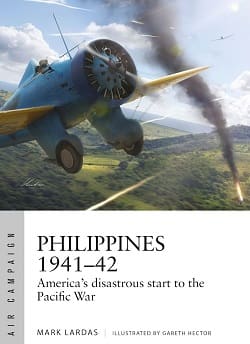
by Mark Lardas.
Softcover (7.25×9.75 inches). 96 pages. 2026.
Subtitle: America’s Disastrous Start to the Pacific War
This broad overview covers the US deployment of air assets to the Philippines just prior to the Japanese bombing of Pearl Harbor and subsequent invasion of the Philippines. The successful Japanese air assault on the US Far East Air Force came down to successful planning, American command confusion, and a little bit of luck.
The assortment of US aircraft in the Philippines were mostly obsolete, although a goodly number of B-17s and P-40s were based on the islands. After news of the Japanese attack on Pearl Harbor reached the Philippines, MacArthur proved to be unavailable and requests for a strike on Formosa airfields went unanswered. In frustration and with an order not to allow the US aircraft to be bombed on the ground, the US planes were sent aloft, without bombs, just to get them up in the air.
Here’s the luck part. Fog over Formosa delayed the initial Japanese air strikes at Clark Field and other airfields. By the time the US planes sent aloft had to land for refueling, it was lunchtime, so all work was abandoned. Even the radar site didn’t seem to have an operator and the phone line between site and airfield was also down. You guessed it, the Japanese arrived right then with US planes lined wingtip to wingtip for faster refueling. Carnage resulted.
The booklet contains 57 black and white photos, two black and white illustrations, two color illustrations, nine color maps, two color photos, and three color two-page action illustrations.
It reads quick, it reads well, and follows the usual Air Campaign format — including tinier fonts than the regular Campaign booklets. Other than that, an excellent volume in the series.
Enjoyed it.
— Reviewed by Russ Lockwood