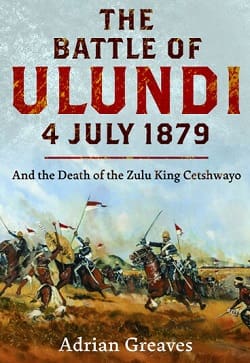
by Adrian Greaves.
Hardback (6.3×9.5 inches). 200 pages. 2026.
Subtitle: And the Death of the Zulu King Cetshwayo
After the better known battles of Rorke’s Drift and Isandlwana, the British regrouped and advanced back into Zululand to attack King Cetshwayo’s capital at Ulundi. The British commander, Lord Chelmsford needed to regain his reputation before the replacement British commander, Sir Garnet Wolsely, arrived to take over. Not to worry, after Chelmsford took Ulundi and left, Wolsely had other major and minor Zulu kings to attack and subjugate.
While it makes sense given that Isandlwana had a massive mountain and Boers used various kops, I learned about how the Zulus would use caves to ambush and confound the British. The British engineers blew up the cave entrances,sometimes to good effect and sometimes not. The book does an excellent job of explaining how terrain affected operations.
Of note, King Cetshwayo was sent to London and met Queen Elizabeth and ultimately returned to Zululand. His son, Prince Dinuzulu, tried to reform his inherited Zulu kingdom, failed, and was eventually exiled to the island of St. Helena (p103). Oh sure, you hear all about Napoleon’s stay, but this is the first I heard about Her Majesty’s government welcoming Dinuzulu to its island prison.
One typo: “weight Taking” (p98) is missing a period after “weight.”
The book contains eight black and white illustrations (including a sketch of the British square at Ulundi) and seven black and white photos. Needs area maps, though.
Greaves does an excellent job of explaining the campaigns of Chelmsford and Wolsely, and to an extent the first encounters against the Boers. If you’ve already done Rorke’s Drift, Isandlwana, and Hlobane, you might put those Zulu and British tabletop miniatures to good use fighting the campaigns and battles within this book.
Enjoyed it.
— Reviewed by Russ Lockwood