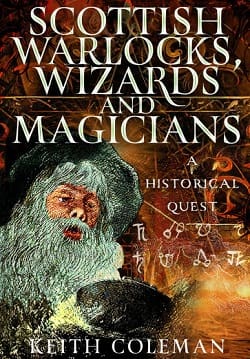
by Keith Coleman.
Hardback (6.3×9.5 inches). 206 pages. 2026.
Subtitle: A Historical Quest
Being the season of witches, I figured this title would be appropriate — and it was. However, it’s a hodge podge lodge of disconnected pluckings from the pages of books and presumably the scourings of the internet.
Basically, a subclass of society made its living as traveling charm salesmen and women. From curing illness to protection from evil, these women and men sold magical protections from evil — and Scotland was full of faeries, the Devil, and other purveyors of ill will. Oddly, a not insignificant part of the 16th and 17th century population paid homage to the Devil in a variety of ways, including setting aside a plot of the farmland for the Devil’s use. Of course, if you tried to plow a Devil field or a faerie hill, oxen would drop dead, you’d catch a malady, or some other hardship would occur.
Church and town officials took a dim view of all this, and folks who suffered some wrong would accuse someone of witchcraft and so began trials and executions. “She turned me into a newt…I got better.” ran through my mind.
The problem with all this is that all the anecdotes get piled atop each other. Some semblance of organization occurs within chapters, but not much. The rapid changing of people and places within a paragraph makes it a jumble and hard to read.
While nothing within is of much use in tabletop battles, you can probably pull out an anecdote or two for an RPG setting.
A couple typos: “economic burden of maintaining these roaming bards and their extensive revenues” (p88) seems odd — can “extensive revenues” be a burden? A secondary definition I’m not familiar with? And “distinction His” (p130) needs a period after distinction.
And while not typos, sometimes footnoted passages use the old spellings and don’t contain an English translation, but other times do. After all the work I had to do to read the regular text, I soon passed over such untranslated text. My Scottish ancestors probably wouldn’t have trouble, but their 21st century descendant did.
The book contains one black and white map, five black and white photos, and 14 black and white illustrations.
I’m not sure what the editor thought of this accumulation of excerpts, but I would have sent it back to the author and said rewrite it to create a coherent narrative. Maybe this was made for doom-scrolling, where your attention span is measured in partial sentences. Dunno. I do know that the research — and web scouring — is here, but not a sense of cohesion to the topic.
— Reviewed by Russ Lockwood