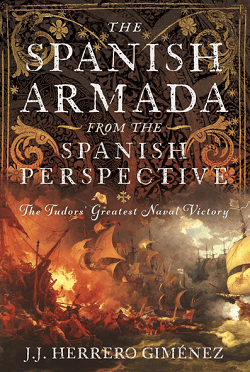
by J. J. Herrero Gimenez.
Hardback (6.4×9.5 inches). 212 pages. 2026.
Subtitle: The Tudors’ Greatest Victory
I am a bit ambivalent about the book. On the one hand, getting a Spanish viewpoint that plumbs the depths of Spanish archives is a big bonus. On the other hand, the text is not exactly what I was expecting. It seemed to me to be a little off. A little simplistic. A little meandering. A little … off.
Now, I’m not sure if it is due to a translation issue. But I wager no English human editor touched these pages. A dearth of paragraphs breaks, and I mean page after page of solid text with nary an indentation, is one clue. In the very least, formatting is a problem. This is a hard book to read, partially because you don’t get any breaks and partially because critical points that should be separated by indentations ram into each other again and again.
On the plus side, clawing out the details is rewarding. A great Spanish OOB (p60-62) is balanced by an English OOB that suffered from Elizabethan security and a haphazard way in which English ships joined the English fleet.
The battle itself highlights the difference between the myth of an Armada crescent formation and the actuality of three separate Spanish formations with skillful maneuvering. Spanish naval training was second to none in theory and practice.
Spain launched 128 ships for the attack on England, of which 91 returned in various states of distress. Most of the ships sunk were from storms and accidents, especially on the west coast of Ireland, not English gunfire. Only three ships were sunk by gunfire and five captured (p94). Of note, not all the ships were Spanish — many were rented from other areas and with a variety of seaworthiness, too. Spanish cannons were heavier than the English and firing was a deliberate three to four shots per hour. The lighter cannons could fire at about six shots per hour (p104).
The English took 2,998 prisoners, of which 1,120 were executed, 315 died of natural causes in prisons, and 1,558 were ransomed (p92). The executions surprised me.
One factoid caught my eye. I’m now adding Sir Francis Drake to my list of book-burning morons (that’s the polite term, anyway). In 1586, when privateering against the Spanish, he captured Santo Domingo and, among other buildings, burned the oldest Spanish archive in the Americas (p38).
A couple typos: a photo caption says “sixteenthth” with an extra “th” and “his authority” (p185 footnote 22) should be “her authority” for it references Queen Elizabeth.
The book contains 18 black and white illustrations, 12 black and white maps/ship battle diagrams, and one black and white photo.
Much to like and dislike. Part of it might be the approach — his MFA degree is in Media Communications and he does film distributing, historical novels, and a couple history books, sez his bio. If the bibliography is any indication, he ransacked the Spanish archives and period Spanish-language books as well as modern English and Spanish journal articles and books. It’s just hard to read. Still, ties go to the author for the topic.
Enjoyed it.
— Reviewed by Russ Lockwood