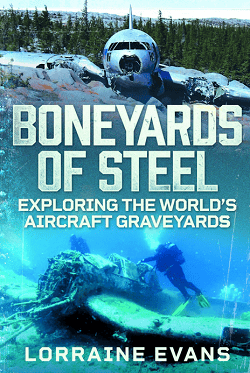
by Lorraine Evans.
Hardback (6.3×9.5 inches). 215 pages. 2026.
Subtitle: Exploring the World’s Aircraft Graveyards
You’ve probably heard of a desert US airbase in Arizona that mothballs military and civilian aircraft just in case they are needed again. For example, a B-52 was pulled and refurbished relatively recently-ish. I guess it’s less aircraft graveyard than aircraft purgatory.
It may not surprise you that this is not the only place aircraft are or were stored. During WWII, the US produced 295,000 aircraft (p2) of which about 150,000 were surplus after the war. Those that weren’t sold or given away as military aid were scrapped to recover various metals. Of note, of that 295,000, 21,583 were lost to accidents in the US. Sometimes, aircraft that could not be repaired were stripped for parts or scrapped were just buried. Iraq buried MiG fighters during the US invasion once the Coalition forces achieved air supremacy.
In any case, the book details sites of buried, scrapped, displayed, or stored aircraft through modern times. From government sites to individuals to sunken remains, this book travels the world (or at least the internet) to catalogue them. I gotta give the guy in Bulgaria credit — he put a MiG-21 in his garden. A shout out to entrepreneurs who turned aircraft junkyards into “museums.”
The book contains 39 black and white photos. Allow me to contribute one from my father-in-law’s photo collection — he took it while stationed on Guam during WWII. This was a major B-29 base for the bombing of Japan and had its share of accidents and shot-up planes that made it back. One of these wrecks may have been his as he once related the story that his aircraft landed on the beach just short of the runway.
In any case, if you’re interested in aircraft wrecks, repurposed planes, parts used as commemorative markers or tombstones, or those in storage, this book offers a compilation of all of the above. It’s sometimes a bit rapid fire, but you gotta smile when an exploration of Loch Ness in 1976 didn’t find the monster, but did find a WWII Wellington bomber, which was raised in 1985 (p51).
Enjoyed it.
— Reviewed by Russ Lockwood