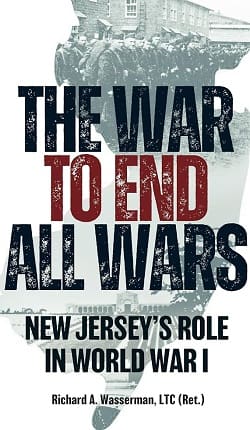
by Richard A. Wasserman
Softcover (6.0×9.0 inches). 225 pages. 2026.
Being from NJ, I was rather intrigued about NJ’s participation in WWI. Apparently, a lot.
NJ companies manufactured munitions and ships as well as mobilized troops to fight in the American Expeditionary Force. A couple massive explosions marred the shipping of munitions, with sabotage suspected in the Black Tom Island explosion of 1916. Other plants also suffered small explosions. Apparently, one safety-plagued munition company’s motto was “Safety is Job 2.”
The book includes a section on military hospitals in NJ, contributions by women (telephone exchange operators being the most pronounced improvement over men), and battles and actions, especially the Meuse-Argonne offensive, and especially the 29th and 78th Divisions.
The chapter on monuments, markers, and other memorials here and in Europe was interesting, with one exception. An obscure fact is that the US did not officially end the war until 1921, when President Harding signed the documents at an estate in Raritan, NJ. A marker commemorates the event, and here is a gaffe: a small monument is “near the Flemington Circle” (p. xix).
Now, I have driven in, through, and around that traffic circle for 40 years, not to mention entering stores around it, and never heard of this monument. Didn’t seem right, but then again, I’ll be the first to admit that you can learn something new every day and there’s nuthin’ new like history. Unfortunately, that’s all the info in the book, so I went online to track down this monument.
It’s the Somerville Circle, not Flemington Circle, or about 15 miles away. Next time I’m that way, something to look for it.
Other typos: “Great Britian” (p40) should be “Britain,” “the78th Division” (p67) needs a space, “elope” (p97″ should be “slope,” and “Thedore Roosevelt” (p162) should be “Theodore.”
As for the rest, the Military Park memorial in Newark was designed by Gutzon Borglum, he of Mount Rushmore fame, and includes the sculpture Wars of America, which depicts 42 workers and soldiers representing the entirety of a nation mobilized for war (p140). The Spirit of the Doughboy statue is in Belmar, Dover, Fair Haven, Frenchtown, Matawan, Perth Amboy, Roselle Park, and Secaucus. An impressive WWI monument, built in 1925, is in Montclair and depicts a WWI soldier and sailor being shielded by the hoplite-like representation of Columbia — in front of an obelisk topped by winged victory (p142-143). I smell a road trip when the weather is cooler.
The book includes a lot of excerpts from reports, memoirs, and such, which is fine as it goes, but as I said before, excerpts should highlight something, not substitute for prose. Many of them can be summarized and retain the content, and I usually just skipped over the photocopies of lists.
The book contains 183 black and white photos, six black and white illustrations, three black and white maps, and three black and white cartoons.
All states participated in WWI, NJ among them. Hunterdon County, where I live, provided troops for the 78th Division, 311th Infantry Regiment, 2nd Battalion (p70). Most of what happened on the home front and in the front lines is likely mirrored by the other states. But it is nice to read about my own state, and perhaps plot a road trip to see places less traveled.
Enjoyed it.
— Reviewed by Russ Lockwood