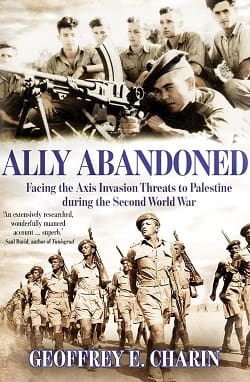
by Geoffrey E. Charin. Hardback (6.3×9.3 inches). 221 pages. 2026.
Subtitle: Facing the Axis Invasion Threats to Palestine During the Second World War
After a bit of a haphazard start, the book settles down into an examination of British foreign policy in the Middle East, specifically Palestine, during the interwar era. The post-WWI straight-line borders that failed to take into account actual divisions among the Arabs exacerbated the impact of Jewish immigration to Palestine.
Although we know the modern post-WWII impact of the creation of Israel, the pre-WWII efforts at creating a sustained lasting peace in the region proved just as muddled as today. One state, two state, and no state solutions fluttered about as the British waffled. An Arab rebellion in the 1930s was suppressed as the British also kept a lid on a Jewish rebellion. Meanwhile, WWII broke out and the Brits refused to create a Jewish division, even though plenty of volunteers stepped forward as Rommel raced towards Alexandria and the Suez Canal.
Ultimately, small Jewish and Arab battalions were formed and the Jewish force grew into a regiment that was sent to Italy in the last stages of the WWII.
Before that, despite ample evidence of persecution and later the Holocaust, the British refused to allow more than a few thousand Jewish immigrants per year. Even ships with Jews who escaped Axis Europe were turned away. The reason? German agents could slip into the territory among the refugees.
Of interest as a what-if scenario would be the Final Fortress Line in Palestine that stretched from Haifa to Nablus (thankfully, with a map showing the five strongpoints). This assumes that the Germans took the oilfields of the USSR and marched through Iran and Iraq to attack Palestine from the northeast. Each strongpoint sector would have three battalions, anti-tank guns, and artillery to delay the Germans and slowly fall back to the Suez Canal (p90).
The book contains 24 black and white photos and four black and white maps.
Obviously, thousands of years of contention between Arabs, Jews, and various occupiers make for a volatile region. The 1920s and 1930s contributed to said volatility and after WWII, even more so. I didn’t have much knowledge about the region and period, but here’s a good place to start on an oft-overlooked period.
Enjoyed it.
— Reviewed by Russ Lockwood