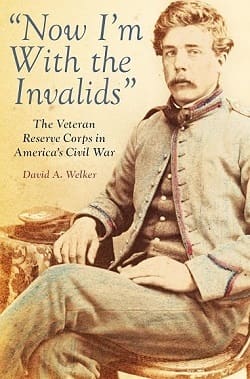
by David A. Welker.
Hardback (6.3×9.3 inches). 318 pages. 2026.
Subtitle: The Veteran Reserve Corps in America’s Civil War
Conventional wisdom of the American Civil War said that the North had plenty of troops to replace the losses suffered in the first couple years. This book tells a slightly different tale about the manpower requirements being so heavy, even conscription needed help to fill the ranks.
Enter the Invalid Corps, later renamed Veteran Reserve Corps. Soldiers who had been wounded, but still effective enough to perform secondary functions. They served as prisoner guards, nurses, escorted draftees to their units, and on occasion quelled draft riots. This allowed fully fit soldiers to be transferred to active combat.
About 20.8% of draftees failed to report to their units (p119), so tracking them down and making sure all reported was an important part of keeping the Union war effort going. On the positive side, they also ensured draftees with bounty money were not targeted by robbers.
On occasion, they battled Confederate raids and in one case, they defended against Early’s 1864 raid — a nice scenario that includes a map.
The Confederates also started an Invalid Corps on Feb. 17, 1864 for non-battle duties, but didn’t, or couldn’t, put in the resources needed to create a robust Corps.
Of note, the original When Johnny Comes Marching Home lyrics (p213) included a line about the Invalid Corps.
One maybe typo: Cap Cadwallader (p226) might be Camp Cadwalader.
The book contains eight black and white maps, 16 black and white photos, and two black and white posters.
I didn’t know about the Veteran Reserve Corps, nee Invalid Corps, and so came away the wiser about Union manpower retention and use.
Enjoyed it.
— Reviewed by Russ Lockwood